Architecture Modernization in Legacy AWS Cloud-Native Systems
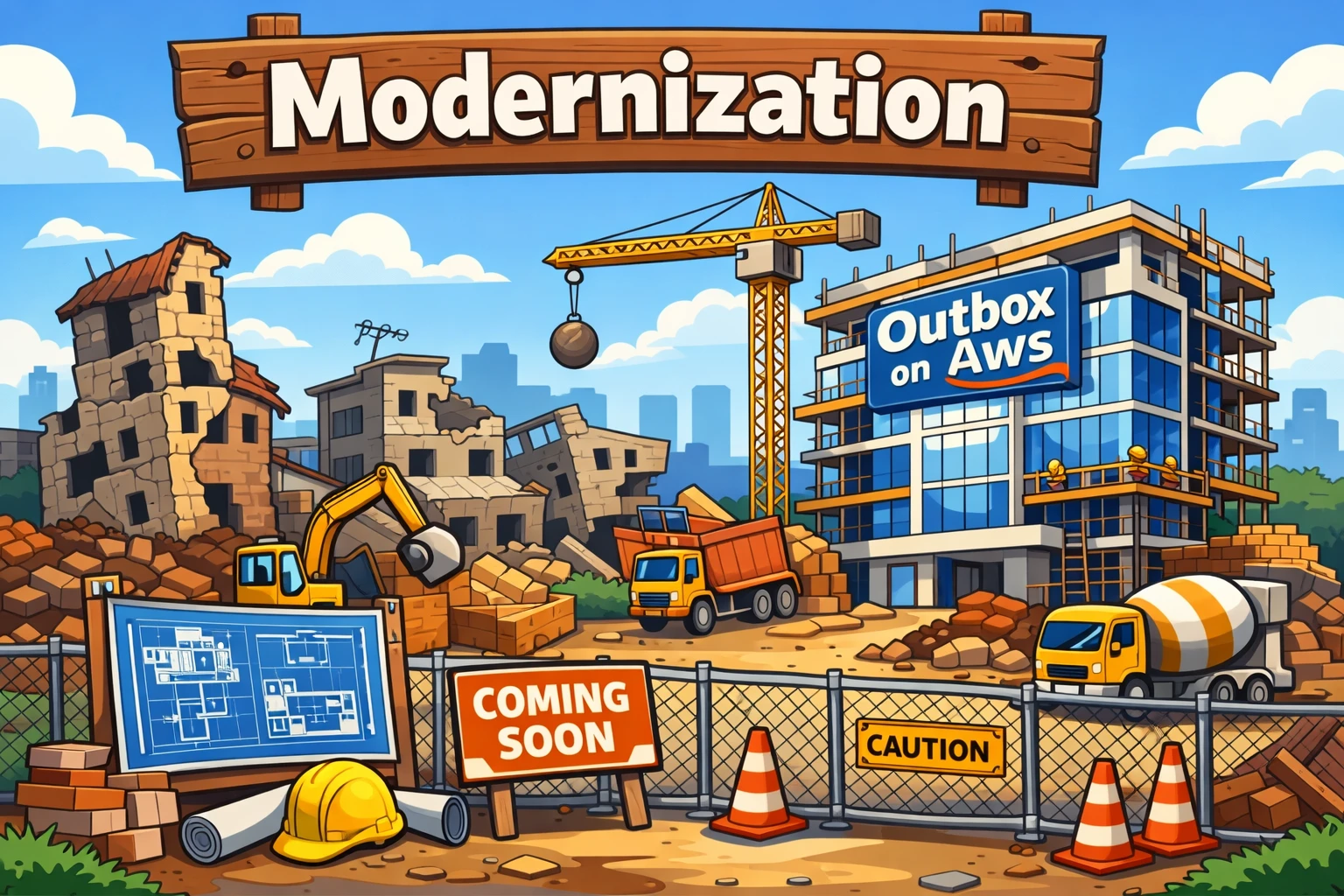
Oh, you commercial project. You bastard.
How much I’ve sworn at you—only to finally realize how much I needed you. Your tangled, countless tentacles resemble a parody of an octopus; your surprised, pained face gives the impression that even you’re wondering how you became a failed genetic experiment.
But… you’re perfect.
Maybe it’s the environment you live in—the variables, the surrounding entropy, the uncertainty—that made you this way.
Now the ecosystem has changed. The waters of time have overflowed, reshaping everything they touch. And here you are, facing a new reality.
You must adapt.
Or die?
No. Not necessarily.
Legacy Projects and Modernization
Projects are often a mess. They flow from one team to another, and teams vary in experience and mentality. There is rarely a concise architectural vision.
Recently, I joined one of those projects — and that is a good thing.
A full rewrite is rarely an option, and even more rarely a necessity. A rewrite means hundreds of man-days, which translates directly into a lot of money — an investment that will probably never pay for itself.
Architecture modernization is mainly about understanding and rediscovering the domain, but in this article my focus is purely technical.
I will cover only one case. If you have ever dealt with — or are currently working with — a legacy AWS cloud-native tech stack, this text is tailored for you. You are welcome, dear Reader.
New Scaffolding Pattern
My project is a legacy cloud-native application running on AWS: tons of tangled Lambdas coupled through a shared kernel (a horizontal one crossing multiple bounded contexts — sic!), DynamoDB tables that heavily mix read and write models, Firehose, Glue, Redshift, and more.
The previous contractor company working on this product figured out that they could implement side effects by calling them one by one at the end of a Lambda. No separation. No real contexts.
But you and I know that the best method of dependency inversion is events.
You can read one of my previous articles where I explain how events are fruitful for implementing domains. You can also catch up on a longer explanation of why traditional CRUD, transaction scripts, and layered architectures are not a good path.
I decided to introduce a new foundation for system communication by publishing events to Simple Queue Service (SQS) and using it only for new parts of the system (new features).
I call this the New Scaffolding Pattern. Thanks to this approach, the development team does not have to get bogged down trying to modify a distributed big ball of mud or escape constant regressions.
Ultimately, this enables us to apply the Strangler Fig Pattern. Maybe. Someday.
See Image 1 to grasp the high-level plan for introducing the new scaffolding.
Communication between the legacy part and the new part is handled, traditionally, by an anti-corruption layer.
How to Introduce Events?
In an AWS cloud-native setup, SQS is a natural choice. However, switching tools alone is not enough.
Before anything else, we must remember:
- We are talking about domain events, and domain events express — unsurprisingly — the domain.
- Events are not notifications sent at the end of an operation just to inform other parties. There is a command, the command produces events, and those events drive state changes and read models.
- Change Data Capture (CDC) is not events. CDC produces data streams, not business facts.
- CDC feeding a data warehouse cannot be treated as domain events.
ℹ️ There are many more rules of thumb and good practices related to events, but this is not the place to cover them all.
I highly recommend the work of Oskar Dudycz. Here are some useful links:
- Event transformation
- Anti-pattern: State obsession
- Anti-pattern: Property sourcing
- Versioning patterns
In my opinion, the most seamless, resilient, and reliable option is to implement the Outbox Pattern using cloud-native components.
Why?
- We get all the benefits of the outbox pattern: data persistence and event publication in an atomic way.
- It is easy to achieve with AWS services.
- The codebase does not need to reference queues directly; it continues to work with DynamoDB as usual.
Cloud-Native Outbox to the Rescue
To implement the outbox pattern reliably, we rely on:
See Image 2.
How It Works
- DynamoDB Streams start the mechanism. Multiple outbox tables are defined per bounded context.
- A Lambda consumes the stream records, transforms them into domain events (adds identifiers, metadata, structure), and publishes them to an SNS topic.
- SQS queues receive events. Since SQS is a queue (not a log), messages are deleted once consumed.
- SNS handles fan-out by duplicating events into multiple queues using subscriptions and filters.
- When an event reaches its target SQS queue, it triggers the appropriate domain Lambda.
Reliability Guarantees
- If a DynamoDB stream record is not processed successfully within the 24-hour retention window, it is routed to a Dead Letter Queue (DLQ) via Lambda Event Source Mapping.
- If a message cannot be processed successfully from SQS after a configured number of retries, it ends up in an SQS-managed DLQ.
- Use
BisectBatchOnFunctionErrorto automatically split failing batches and isolate problematic records, ensuring good records are processed while only bad ones are retried.
Wrap-up
If you are stuck with an AWS cloud-native legacy system — or if you simply enjoy this kind of ride — it is entirely possible to implement a reliable and elegant outbox pattern.
However, patterns like outbox and events, despite being good practices, must serve business goals and speak the domain language. Events themselves are not the solution. Good architecture is.
The New Scaffolding Pattern supports your team and your delivery calendar by enabling new features to be built on clean architectural foundations, while gradually cutting off the burden of the legacy system.
Who said brownfield projects cannot still have green fields left to sow?
HermesJS 🫒🌿
But you miss a lot of things in this ecosystem. You miss a chassis.
Hermes PostgreSQL and Hermes MongoDB are part of the initiative that delivers to you a foundation of a reliable system.
It is a library, not a framework, which relies on PostgreSQL's Logical Replication / MongoDB Change Stream.
It implements the Outbox pattern. You can span a database transaction over persisting an entity and publishing a message.
Go to the docs!
Give a start on the GitHub!